 Parler
 Gab
Gab Copy
Copy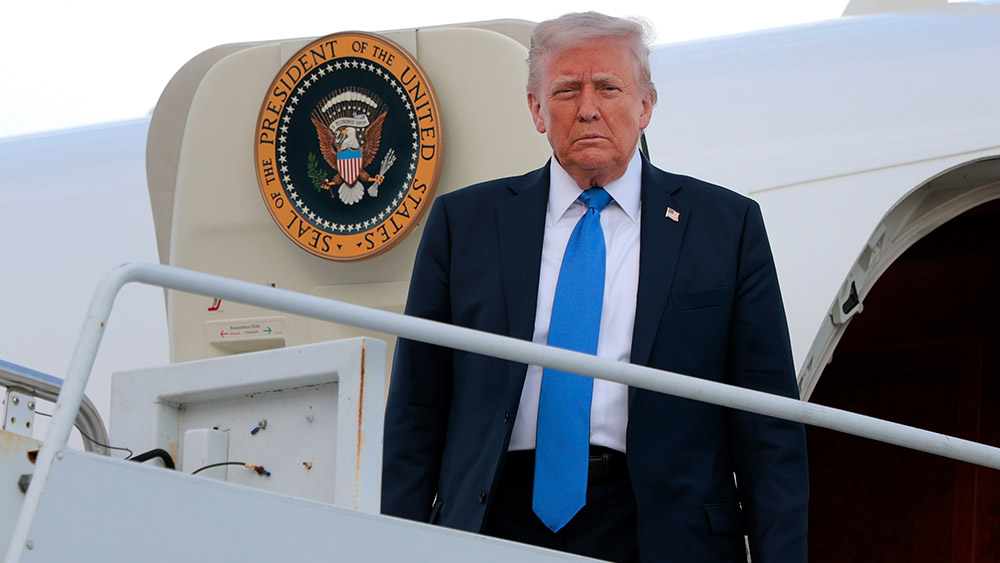
- President Donald Trump arrived in Beijing this week for a two-day summit with Chinese President Xi Jinping beginning May 14.
- Trump seeks China's help to end his unpopular Iran war, with over 60% of Americans disapproving of the conflict.
- Trade discussions focus on extending a fragile truce with modest deals on agriculture, aerospace and energy.
- Taiwan arms sales remain a key sticking point, with Beijing demanding the U.S. revise its policy toward peaceful reunification.
- Low expectations dominate as Trump faces court rulings against tariffs and Xi contends with domestic economic challenges.
A president in need of a win
President Donald Trump arrived in the Chinese capital Wednesday for high-stakes talks with Chinese President Xi Jinping, carrying the weight of an unpopular Iran war, emboldened trade rivals and a pressing need for foreign policy victories. The May 14-15 summit at the Great Hall of the People comes one year after Trump predicted towering trade tariffs would bring America's main economic rival to heel. Instead, court rulings have blunted his leverage, while the conflict with Iran has drained his approval ratings and sent energy prices soaring. More than 60% of Americans disapprove of the Iran war, according to a Reuters/Ipsos survey last month. Trump departed Joint Base Andrews on Tuesday with a delegation including Tesla CEO Elon Musk, Apple CEO Tim Cook and Nvidia CEO Jensen Huang. The group is smaller than his 2017 business delegation, reflecting diminished expectations for what analysts describe as a summit where Trump "kind of needs China more than China needs him."The Iran factor: Beijing as broker
The most pressing item on Trump's agenda is enlisting China to pressure Tehran into a diplomatic resolution of the Iran conflict. China maintains close ties with Iran and remains a major consumer of its oil exports, giving Beijing significant influence over the Islamic Republic. Trump has credited China with helping bring Iran to the negotiating table previously. He told reporters before departing Washington that he expected "a long talk" with Xi about the war but said trade would dominate the discussions. "I don't think we need any help with Iran. We'll win it one way or the other," Trump said.Trade truce under strain
Trade negotiations will test both leaders' ability to stabilize relations after Trump's tariff regime faced significant legal setbacks. The U.S. Court of International Trade last week struck down Trump's 10% global tariffs, constraining the White House's ability to employ coercive economic measures. Since Trump and Xi last met at an airbase in South Korea in October 2025, where they paused their bruising trade war, China has quietly expanded its economic leverage. Beijing enacted laws to punish foreign entities shifting supply chains away from China and tightened its rare earth licensing regime. China controls the dominant share of extraction and refining of rare-earth materials critical to modern technology and weaponry. During the 2025 Busan meeting, China agreed to a one-year reprieve on rare-earth mineral export controls, an arrangement Trump described as likely to be "routinely extended."Taiwan: The core disagreement
The most sensitive topic facing Trump and Xi is Taiwan, the democratically governed island that Beijing claims as its territory and has vowed to bring under its control by force if necessary. China wants the United States to revise its stated policy on Taiwan's status to favor "peaceful reunification" between the island and mainland China, instead of the current position calling for "peaceful resolution." Chinese Foreign Minister Wang Yi described Taiwan as "at the very core of China's core interests" during a recent call with Secretary of State Marco Rubio, who is accompanying Trump. Trump has alarmed Taiwan supporters with comments suggesting he and Xi would discuss U.S. arms sales to the island, which some experts say would violate long-standing U.S. policy prohibiting such consultations with Beijing. Asked Monday about selling arms to Taiwan, Trump acknowledged the issue would arise: "President Xi would like us not to, and I'll have that discussion. That's one of the many things I'll be talking about."Modest expectations, historic stakes
The summit's schedule includes a welcome ceremony, meetings at the Great Hall of the People, a tour of the UNESCO-heritage Temple of Heaven, a state banquet Thursday evening, and tea and a working lunch Friday before Trump departs for Washington. The two leaders are expected to meet at least one more time this year when Trump hosts Xi in Washington. The outcome of this week's talks will shape not only the U.S.-China relationship but also the trajectory of conflicts in the Middle East and the balance of power across the Indo-Pacific.Diplomacy under duress
Trump's Beijing summit represents a critical test for a president facing multiple crises simultaneously. The Iran war has created a global energy crisis, his tariff strategy has been partially dismantled by courts, and China has spent the past year expanding its economic leverage. The modest expectations reflect a fundamental shift: Trump arrives not as a dominant negotiator dictating terms but as a leader seeking stability and a foreign policy win to shore up his domestic standing. For Xi, the summit offers an opportunity to burnish China's status as a global power broker while pressing for concessions on trade and Taiwan. The outcome will likely be what analysts describe as a "superficial ceasefire" that benefits Beijing more than Washington. Sources for this article include: Reuters.com FoxNews.com NBCnews.com
NATO scrambles jets as Swedish leader urges help directing Ukraine’s drones
By Cassie B. // Share

Iowa law requires parental consent for HPV, hep B vaccines, reversing minor consent policy
By Willow Tohi // Share
Trump: U.S. Will Seize or Destroy Iran’s Enriched Uranium Stockpile
By Garrison Vance // Share
China Raises Fuel Price Caps Again as Iran War Keeps Oil Markets on Edge
By Garrison Vance // Share
Why China Is Winning the AI Race (and Why America May Never Catch Up)
By Mike Adams // Share

Strait of Hormuz remains effectively blocked as NATO, Iran tangle over shipping security
By Willow Tohi // Share



Ukraine’s Patriot missile stockpile runs dry as Trump-Zelensky feud boils over
By isabelle // Share

Thyroid diet myths busted: Broccoli is fine, but your fancy sea salt isn’t
By isabelle // Share

The Pentagon's Desperate MOAB Plan: A Symbolic Attack That Won't Win the War
By healthranger // Share