 Parler
 Gab
Gab Copy
Copy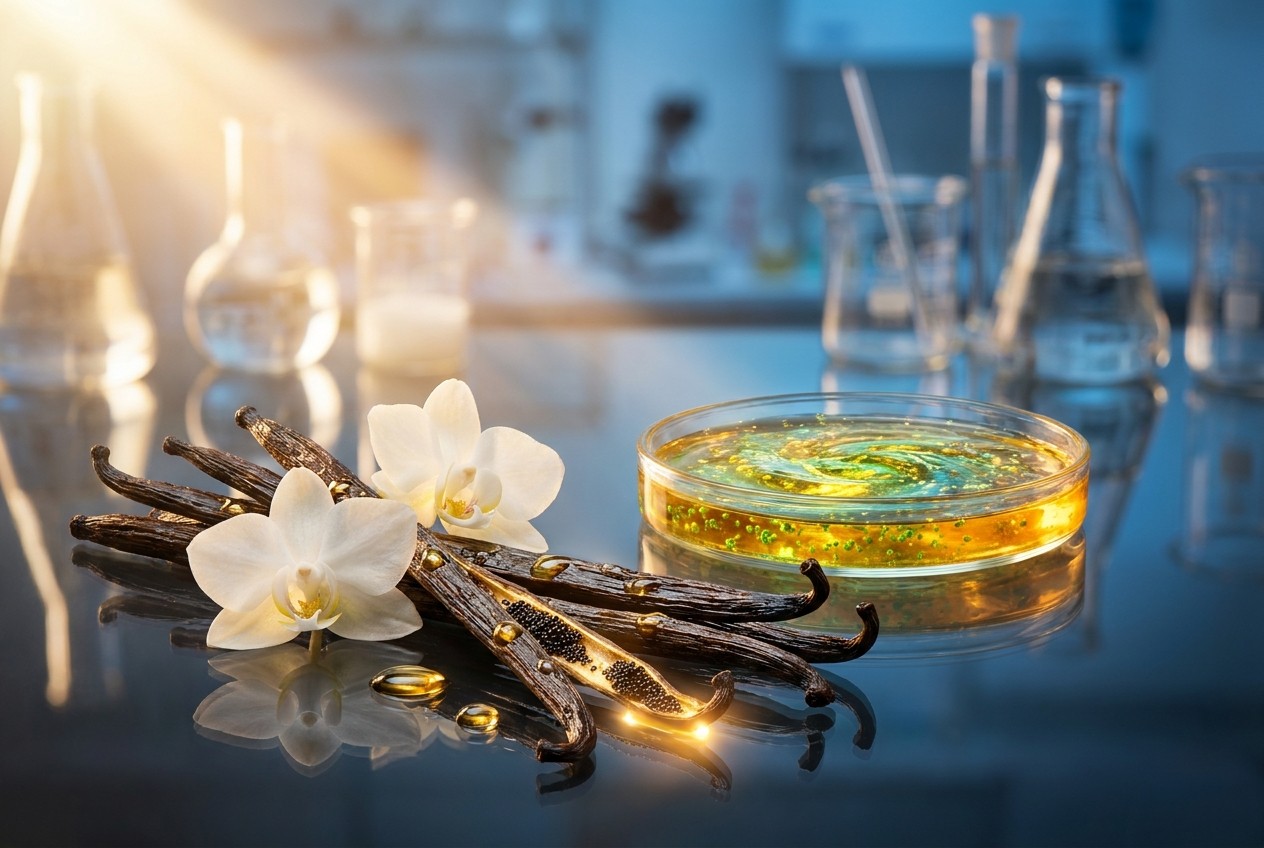
What Researchers Found About Vanillin
Vanillin is the main flavor and fragrance compound found in natural vanilla pods. Separate research has examined the extraction of vanillin from vanilla pods and the production of vanillin from waste residue of rice bran oil by Aspergillus niger and Pycnoporus cinnabarinus, indicating that multiple production pathways exist [4][5]. Researchers have uncovered surprising healing potential in vanilla, revealing that its signature flavor compound could help fight infections, according to the statement [3]. Study co-author Krasimir Vasilev, professor of biomedical nanotechnology at Flinders University and director of its Biomedical Nanoengineering Laboratory, said the compound's established profile in food was central to the research interest. The researchers reported that vanillin's signature flavor compound could help fight infections, according to the statement [3]. Earlier scientific work has also identified vanillin among the minor degradation products of curcumin and has documented radical-scavenging properties of the compound as a flavoring agent [6][7].Potential Applications in Wound Care and Drug Delivery
Oxidative stress occurs when reactive molecules overwhelm the body's protective defenses, potentially damaging cells and interfering with tissue repair, the statement said. A material capable of addressing oxidative stress, inflammation and bacteria could therefore offer several advantages in wound care. Vasilev said the synthetic form of the compound is abundant and inexpensive, a practical advantage when moving a scientific concept toward manufactured medical products. Hydrophobic compounds are substances that do not dissolve easily in water, a characteristic that can make certain medications difficult to formulate and deliver. Vanillin's chemical structure may help researchers design materials that carry such compounds to where they are needed. Researchers also noted that curcumin, a separate plant compound, has shown the ability to enhance wound repair in diabetic patients through studies in diabetic rats that demonstrated earlier re-epithelialization, accelerated neovascularization and higher collagen content [8].Related Peppermint Oil Research Provides Context
Vasilev said the idea began after eating peppermint leaves from a drink eased his sore throat, prompting him to investigate the biological properties behind the experience, the statement said. That inquiry led him to explore the use of plasma technology, a field he has studied for more than 20 years. Plasma processing can be used to modify material surfaces and create thin functional coatings, potentially allowing biologically active compounds to be incorporated into medical products. The team's earlier work with peppermint, published in February 2026, involved the development of a medical coating developed from oil. The coating, created at the nanoscale, was designed to protect against bacterial infection, inflammation and oxidative stress while remaining compatible with human tissue. The statement said the work with peppermint helped establish an approach that researchers are now extending to vanillin.Limitations, Next Steps and Conclusion
Vasilev said progress would depend on collaboration across sectors. The report identifies possible future medical uses for vanillin but does not claim proven clinical treatments [3].References
- Vanillin as a bioactive component in biomedical formulations for chronic wound healing and tissue regeneration. International Journal of Pharmaceutics. http://dx.doi.org/10.1016/j.ijpharm.2026.127263
- Vanillin provides a sweet solution for chronic wound healing. https://phys.org/news/2026-10-vanillin-sweet-solution-chronic-wound.html
- Scientists discover vanilla's hidden healing potential. https://www.sciencedaily.com/releases/2026/10/261011211550.htm
- Characterization of Spanish tomatoes using aroma composition and discriminant analysis. by BioFax. Food Sci Technol Int 15, (1) 47-55 (2009)
- Production of vanillin from waste residue of rice bran oil by Aspergillus niger and Pycnoporus cinnabarinus by Elsevier. Food and Bioproducts Processing 2006 84(1):59-64 [2006]
- Effect of heat processing of spices on the concentrations of their bioactive principles: Turmeric (Curcuma longa), red pepper (Capsicum annuum) and black pepper (Piper nigrum) by Elsevier. Journal of Food Composition and Analysis 20 (2007)
- Aroma of fresh strawberries is enhanced by ripening over red versus black mulch by BBI. J Agric Food Chem 50, (1) 161-165 (2002)
- Plant-Based Functional Foods and Phytochemicals by Megh R. Goyal; Arijit Nath; Hafiz Ansar Rasul Suleria; & Arijit Nath & Hafiz Ansar Rasul Suleria
Explainer Infographic

Rutgers, USDA Researchers Report Yeast Compounds Repel Spotted-Wing Drosophila in Cage Tests
By Chase Codewell // Share
Ashwagandha: The timeless herb fusing ancient wisdom and modern wellness
By Ava Grace // Share

Study Links Higher-Dose Vitamin D to Better Cognition in Adults With MCI and Poor Sleep
By Coco Somers // Share

How fear itself fuels the agony of inflammatory bowel disease
By Ava Grace // Share
The healing power of Jasmine essential oil: A comprehensive guide
By Laura Harris // Share

UT Austin Study Links 10 Minutes of Daily Exercise to Deeper Sleep
By Edison Reed // Share

North Korea confirms tactical missile upgrade in new provocative launch
By willowt // Share


Russia claims Ukrainian supply robots destroyed in Kharkov as encirclement tightens
By isabelle // Share
Democrats press CDC director over Trump order giving parents more vaccine choice
By isabelle // Share

Why You Will Survive the Coming Chaos
By healthranger // Share

Five High-Alert Action Items to Accomplish Before the End of 2026
By healthranger // Share